

Meeting with Pushpendra Saroj, Member of Parliament (Kaushambi)
October 21, 2026



 By
user
The way people discover legal services has changed significantly. Today, individuals, businesses, and organizations frequently use online platforms to research lawyers, explore legal expertise, and learn about law firms before deciding whom to contact.
For legal professionals, having a strong online identity is about more than simply being present on the internet. It involves communicating expertise clearly, presenting professional information accurately, and making it easier for people to understand the services offered.
A well-planned digital presence can help lawyers and law firms establish a consistent professional identity while making their information more accessible to relevant audiences.
ReadyCoder Private Limited works with legal professionals to develop websites and digital strategies that support professional visibility, online communication, and a structured digital presence.
A lawyer’s professional reputation is built through knowledge, experience, integrity, and the quality of their work. A digital presence can help communicate these qualities to people researching legal services online.
When someone visits a law firm’s website, they may look for information about its practice areas, professional background, legal expertise, and contact details. If this information is difficult to locate or presented inconsistently, visitors may struggle to understand whether the firm offers the services they need.
A clear and professionally organized online identity helps address this challenge.
An effective digital presence can help legal professionals:
Online branding does not replace professional reputation. Instead, it provides a structured way to communicate relevant information about a lawyer or law firm.
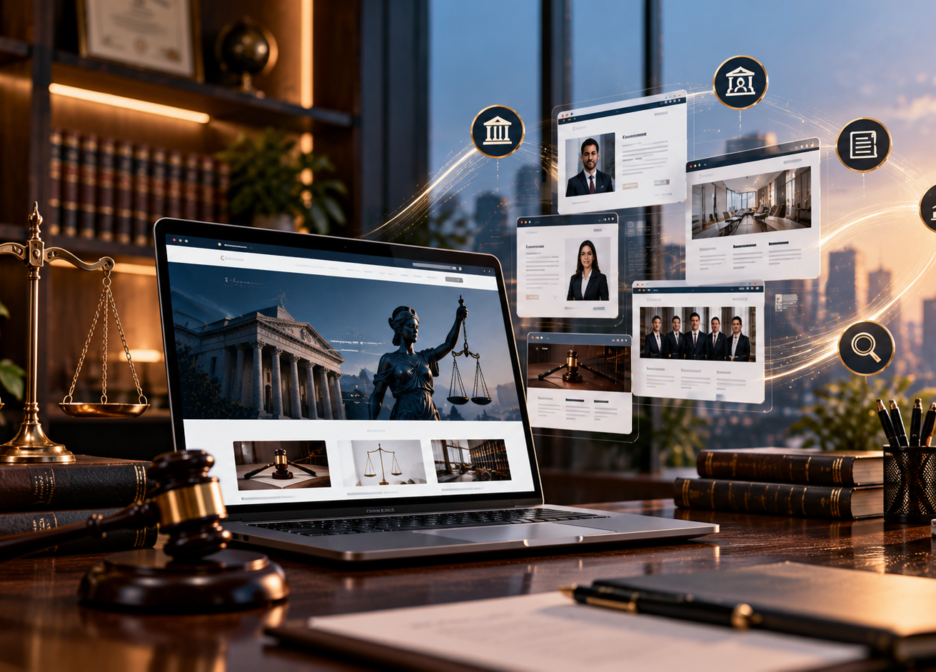
A website is often a central component of a law firm’s online identity. It provides a dedicated platform where legal professionals can present their services, experience, professional profiles, and relevant information.
A well-designed law firm website should prioritize clarity, accessibility, and usability. Visitors should be able to understand the firm’s practice areas and navigate to important information without unnecessary complexity.
Important website elements may include:
Professional profile pages: These pages introduce lawyers, explain their professional backgrounds, and communicate their areas of expertise accurately.
Practice area pages: Dedicated pages help explain the legal services offered and provide useful context for visitors searching for particular types of legal assistance.
Mobile-friendly design: Responsive layouts allow visitors to access information across smartphones, tablets, and desktop computers.
Clear navigation: A logical website structure helps visitors locate relevant information and understand how different services relate to one another.
Accessible contact information: Clearly presented contact details and appropriate enquiry options make it easier for visitors to reach the firm.
ReadyCoder helps lawyers and law firms develop professional digital platforms tailored to their requirements, with an emphasis on structured content, modern design, and practical functionality.
Explore our Lawyer Digital Growth and Visibility Services to learn more.
Even a well-designed website needs a strategy for helping relevant audiences discover it.
Search engine optimization, or SEO, focuses on improving a website’s relevance, structure, and accessibility for search engines. For legal professionals, this can involve developing useful practice-area content, optimizing website metadata, improving internal linking, and addressing technical issues.
For example, a lawyer who handles intellectual property matters may benefit from clear website content explaining trademark registration, copyright issues, or other relevant legal services.
Similarly, a law firm serving clients in a particular city can organize its website around its actual practice areas and geographic coverage.
Effective legal SEO should prioritize accuracy and usefulness rather than simply repeating keywords. Search engines evaluate numerous factors, and rankings cannot be guaranteed through any single optimization technique.
A sustainable SEO strategy typically includes:
When implemented consistently, these practices can help build a stronger foundation for organic search visibility.
Legal information can be complex, and people often search online to understand legal concepts, procedures, and recent developments.
Publishing useful content gives legal professionals an opportunity to explain relevant topics in a clear and accessible manner. Depending on their expertise, this content may include general legal guides, explanations of statutory provisions, updates on important judgments, and answers to frequently asked questions.
For example, a law firm specializing in corporate law could publish educational material about business agreements, company compliance, or intellectual property protection.
The purpose should be to help readers understand the subject while accurately communicating the firm’s relevant expertise.
A strong legal content strategy should follow several principles:
Accuracy: Information should be carefully reviewed and kept current where necessary.
Clarity: Complex legal concepts should be explained in language appropriate for the intended audience.
Relevance: Articles should address genuine questions related to the firm’s practice areas.
Consistency: A realistic publishing schedule helps maintain an organized content library.
Professional responsibility: Content should respect applicable professional conduct requirements, confidentiality obligations, and restrictions on legal advertising or solicitation.
Useful legal content can support both audience education and a website’s broader search strategy, although publication alone does not guarantee higher rankings or new enquiries.
A professional online identity often extends beyond a website. Lawyers and law firms may also maintain professional networking profiles, business listings where appropriate, and other digital channels.
When basic information differs across these platforms, visitors may find it difficult to identify the correct professional details.
Maintaining consistent names, practice descriptions, contact information, website links, and professional biographies helps create a more organized digital presence.
Professional profiles should accurately reflect qualifications and experience. Outdated information should be corrected, and any public claims should be supported by appropriate facts.
For legal professionals, consistency is especially important because visitors may be evaluating sensitive or consequential matters and need clear, reliable information.
A coordinated approach to digital communication can help ensure that the firm’s website and other online profiles present a coherent professional identity.
LinkedIn can provide another channel for lawyers to communicate professional interests, share educational insights, and maintain connections within their professional communities.
A carefully maintained profile can include accurate information about qualifications, experience, practice areas, and professional activities.
Where appropriate, lawyers may share articles, explain legal developments, or discuss broader industry issues. The objective should be to provide relevant professional information rather than relying on exaggerated claims or promotional language.
Law firms can also use professional content to communicate organizational updates, publish educational resources, and direct readers toward relevant information on their websites.
Consistency between a lawyer’s website biography and professional profiles helps reduce confusion and supports a more organized online identity.
All professional communications should remain consistent with applicable rules governing confidentiality, advertising, solicitation, and professional conduct.
Building an online presence is only one part of an effective digital strategy. Understanding how visitors interact with that presence can help identify areas that need improvement.
Website analytics tools can provide information about traffic sources, popular pages, engagement patterns, and the ways visitors arrive at a website.
Search performance tools can also help website owners understand which queries generate impressions and clicks, which pages appear in search results, and where additional content improvements may be useful.
For a law firm, this information might reveal that a particular practice-area page receives substantial search visibility but attracts relatively few visits. Reviewing its title, description, content relevance, and user experience may help identify possible improvements.
Analytics should be interpreted carefully. Traffic does not automatically translate into qualified enquiries, and visitor data should be handled in accordance with applicable privacy requirements.
Regular performance reviews allow legal professionals and their digital partners to make more informed decisions about website improvements and content priorities.
A credible digital identity develops over time. A new website may establish the foundation, but maintaining its usefulness requires ongoing attention.
Practice areas evolve, professional information changes, search behaviour shifts, and website technology continues to develop. Regular reviews help ensure that the information presented online remains accurate and relevant.
A practical long-term approach may involve updating lawyer profiles, reviewing practice-area pages, improving website performance, publishing useful content, checking technical SEO, and measuring relevant outcomes.
Priorities should be based on the firm’s objectives and available resources rather than the assumption that every digital channel requires equal attention.
By combining professional website development, relevant content, search optimization, and ongoing performance evaluation, law firms can build a digital presence that remains useful beyond its initial launch.
ReadyCoder Private Limited works with lawyers, advocates, and law firms to create digital platforms and strategies suited to their professional requirements.
Our services include law firm website development, search engine optimization, digital content structuring, and broader digital visibility support.
We recognize that legal professionals need digital platforms that communicate information clearly while maintaining an appropriate professional identity. Our approach focuses on aligning website design and digital strategy with each firm’s objectives.
Whether a legal professional needs a new website, an improved practice-area structure, better-organized content, or a more coordinated online presence, the starting point is understanding the specific requirements of the practice.
The aim is to create useful digital foundations that can be maintained and improved as the firm develops.
In an increasingly connected world, a lawyer’s online identity can influence how easily people discover and understand their professional services.
A clear website, useful legal content, relevant search optimization, consistent professional profiles, and thoughtful performance monitoring can work together to strengthen a law firm’s digital presence.
However, a successful digital strategy should remain grounded in accuracy, professional responsibility, and the genuine information needs of its audience.
For lawyers and law firms looking to improve their online presence, the most effective approach is to treat digital communication as an ongoing professional asset rather than a one-time project.
ReadyCoder Private Limited helps legal professionals build and improve their digital foundations through website development, SEO, and tailored digital growth solutions.
Ready to strengthen your law firm’s digital presence?
Explore our Lawyer Digital Growth and Visibility Services or visit ReadyCoder.in to learn more about our services.
ReadyCoder Private Limited — Building digital experiences that move businesses forward.